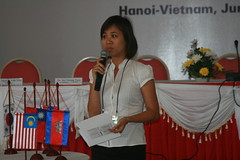
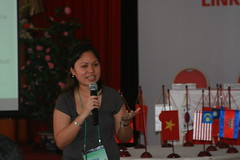
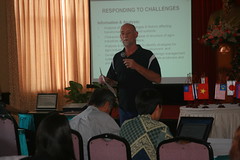
Session 4: Presentation 3: JKCA Experience - Growing Strategy and Activities in the Field (Korea)  

Session 4: Marketing Concepts, Strategies and Intermediation Models

JKCA Experience - Growing Strategy and Activities in the Field (Korea)
Presented by Mr. Chang Hyo Kim, Chairperson, Jeju Kiwi Cooperative Association (JKCA)
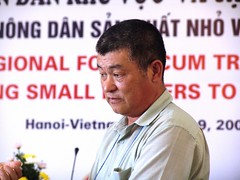
Kiwi production has a bright future in Korea. Through JKCA, kiwi farmers are organized and become stockholders of the association. JKCA buys the kiwi from their members and sell to the retailers, only charging a 1% commission. With one hectare per farmer, kiwi farming has been very profitable earning the farmer a net income of US$50,000/ha. Because of better technology and farming techniques, the quality of the kiwi fruit has also improved.

With local kiwi demand and prices increasing, there is now not enough fruit to export. JKCA would like to adopt an export strategy and for kiwi, part of which will entail producing some of the fruit exclusively for export. This will involve tasks such as improving quality and distribution, training farmers, and pursuing new initiatives such as establishing a kiwi-packaging center and a tourist farm. However, the problem right now is that there is no clear government policy for exporting kiwi (exporters just follow regular business regulations).

As it ventures into trade-related activities, JKCA also needs to ensure that it implements measures to safeguard the market for local kiwi producers. Another area for improvement is strengthening its link to agricultural extension services.

Download the Korea Jeju Kiwi Association.ppt


Read More...
AddThis Social Bookmark Button

Session 4: Presentation 4: CRS Experience - Support to Agro-Enterprise Development in Nghe An Province (Vietnam)  

Session 4: Marketing Concepts, Strategies and Intermediation Models

CRS Experience - Support to Agro-Enterprise Development in Nghe An Province (Vietnam)
Ms. Chu Thi Mai Anh, Agricultural & Rural Enterprise Development Project Officer, Catholic Relief Services (CRS)

The CRS has partnered with the Province of Nghe An to promote a territory approach to agro-enterprise development. This means that the project needs to 1) be implemented through the Government administration structure; 2) improve the skills and knowledge of government staff in promoting market oriented production; 3) promote ownership and sustainability; and 4) aim for policy improvement for poverty alleviation through agro-enterprise development.

Following the 5 processes/steps for agro-enterprise development, the project has strengthened the ability of government agencies in promoting agro-enterprise development and project management. It has also contributed to more diversified agricultural products and improved the lives of target communities (through more jobs, value-added, increase incomes and reduced environmental and health issues)

It is important to note the role that the mass organization of farmers play: they are directly involved as members of the project committee and they are instrumental in helping change the mindset of farmers (i.e. in building relationships with the farmers and informing them about the benefits of collective farming). As a collective group, farmers plan together, establish their own regulations and penalties for violations, and develop contracts that specify quality, quantity, time of delivery, etc. This needs to be sustained.


The support to promote agro-enterprises needs to continue beyond the project. This can be done through transfer of knowledge to government staff and encouraging learning-by-doing. While NGOs are taking on a more forward role becoming entrepreneurs, there is a need to enable farmers to respond to the market and make their own decisions (be entrepreneurs as well).

Download CRS Experience ASIADHRRA LSFM.ppt


Read More...
AddThis Social Bookmark Button

Session 5 Presentation 1: Opportunites with the ASEAN Foundation  

Session 5: Policy Framework and Opportunities to Make Markets Work for Small Farmers

ASEAN Foundation Opportunities
by Renelle Ivy Adan, Program Coordinator

As a funding agency, the ASEAN Foundation can support human resource development projects (capacity development only, no infrastructure) such as those in the agricultural sector. Projects need to meet a set general criteria before they can be approved, such as that they have to be regional or sub-regional in nature (can not be country-based only, and are usually anywhere from 6 months to 3 years in duration. In terms of process, the foundation will request for 3-page concept paper to be submitted before a full proposal is developed. Because of the numerous back and forth between the foundation and the proponent, the project approval process can be quite lengthy (i.e. in the case of AsiaDHRRA with the LSFM project, the process took almost 6 months). All projects then needs to get the approval of the board of trustees, which is composed of the ambassadors of the member countries – a process that takes around two (2) weeks. Since 95% of the foundation’s funding comes from Japan, projects are also sent to them for final approval once approved by the board.

The ASEAN Foundation also provides scholarships on a per university basis. Through a partnership with Hewlett Packard, they have also been able to conduct IT trainings for farmers in Indonesia and will soon do the same for Cambodia and Laos. The foundation will be visiting each member country in the next four (4) months be discuss how organizations (private companies, NGOs, etc) can link up and avail of funding.

Proposals are accepted all year round. Requirements and details of project proposal submission shall be provided to all the participants.

Download Session 5 ASEAN Fdn Opportunities.ppt


Read More...
AddThis Social Bookmark Button

Session 5 Presentation 2: About the FAO  

Session 5: Policy Framework and Opportunities to Make Markets Work for Small Farmers

About the FAO
by David Hitchcock, Agribusiness & Infrastructure Officer

The FAO funds technical cooperation projects (TCPs), which are determined by each country. It would like to be a responsive organization and it sees itself as a source of technical assistance in 1) information and analysis of both national and regional strategies; 2) enabling policies, institutions and services; and 3) supporting specific agro-industries and value chains (i.e. determining the drivers of certain value chains, looking at opportunities and innovative arrangements, etc). At this point, the FAO cannot support infrastructure projects; however it can help determine what kind of infrastructure is needed (soft process)

The FAO can also help emerging NGOs. This is especially relevant given that the role of NGOs has been changing dramatically and there are now many models in the regions that we can learn from. There are also many “failures” in the sense that farmers did not enter the markets for some reason(s), and these are just as important to study and learn from.

As a regional organization, FAO can also help give a voice to small farmers for specific policies and advocacies. For example, the group can come up with a set of recommendations that can be brought to the upcoming regional forum on trade. FAO would be willing to fund a consultant to look at specific issues and facilitate dialogues on what we can do and how we can leverage in order to come up with an action plan.


Download the About FAO.ppt

Read More...
AddThis Social Bookmark Button

Workshop Presentation Papers  

About the ASEAN Foundation

  1. The ASEAN Foundation

Workshop Inputs
  1. Agribusiness And Competitive Agro-Industries In The Asia And Pacific Region
  2. Market Positioning
Cambodia
  1. Map of CSO Marketing Initiatives in Cambodia
  2. Summary Report on Mapping of Marketing Initiatives by CSOs in Cambodia
  3. Value Chain Analysis Framework for the Free Range Chicken
Philippines
  1. Mapping of CSO Market Initiatives in the Philippines
  2. Map of CSO Marketing Initiatives in the Philippines
  3. Rapid Industry Analysis of Banana and Calamansi
  4. Value Chain Analysis of Calamansi
Field Visit
  1. Profile of Phuc Thanh Thai Nguyen
List of Participants
  1. List of Participants, Resource Persons, Guests and Donors

Read More...
AddThis Social Bookmark Button

LSFM Launch Program  

Program of the Formal Launching of the LSFM Project

Read More...
AddThis Social Bookmark Button

LSFM Program of Activities  

View the Program of Activities here

Read More...
AddThis Social Bookmark Button

welcome!  

welcome to the first lsfm workshop blog

Read More...
AddThis Social Bookmark Button