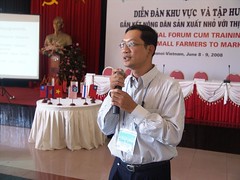
Session 3: In-Country Presentations on Value Chain Studies (LSFM Pilot Projects)
Study 2: Value Chain Analysis of Calamansi (Philippines)
By Mr. Jesus Vicente Garganera, National Coordinator, PhilDHRRA
 A market research scanning on calamansi that was done revealed important statistics and information for any farmer or group of farmers interested in producing and marketing. It was found that the production of calamansi in the country has been increasing, with major supplies coming from Central Philippines (although it can only be produced there 4-6 months in a year because of typhoons) and less but more consistent (all-year round) supplies coming from Southern Mindanao. A minimum of half a hectare is required to make calamansi production successful and it costs around 4 Philippine Pesos (Php) or 9 US cents to produce one kilo of calamansi. Potential returns are estimated to be about US$2000/year for one farmer.
The value chain actors are comprised of the farmer, the assembler or distributor (who brings the calamansi to the capital of Manila), the retailer (markets that make the calamansi accessible) and the consumer. The price increase from farmer to consumer is almost 1000%!
One initial realization was that the simple repackaging from sacks to crates can already added value because it reduces the number of damaged calamansi being delivered. Fresh calamansi can also be processed into juices, syrups, powders, etc as alternative ways of consumption (as well as maximizing the plentiful harvests during seasonal months), and there is an industrial use for it as well. Therefore, another important learning was that it would be worthwhile diversity the value chain analysis to go beyond the fresh fruit. In order to do this, however, more research is required such as identifying potential industrial markets (i.e. laundry, soap and noodle industry), and analyzing the market segmentation so that farmers will know where they can make the most profit. It will also be necessary to share such findings to the farmers (through a report) and build their capacities further.
Finally, considering its rich vitamin C content (100% RDA in one fruit), it may also be beneficial to discover the health/medicinal benefits of calamansi as input into future marketing strategies.
Download the Philippine Calamansi VCA.ppt
Read More...